


A two-week ceasefire to the Iran War entered its seventh day on Tuesday as the U.S. imposed its own blockade of the Strait of Hormuz
MarineTraffic said in a post on X that two tankers approaching the strait Monday turned around shortly after the U.S. blockade began. One of those tankers, the Chinese-owned vessel Rich Starry, was able to make a successful crossing on Tuesday.
At least four Iran-linked ships were reported to have crossed the Strait of Hormuz on Tuesday: Rich Starry, the Murlikishan, the Christianna, and Elpis, while three other non-Iranian ships were also permitted to cross since the start of the blockade.
China’s Foreign Ministry spokesman Guo Jiakun spoke out against the U.S. naval blockade of the Strait of Hormuz on Tuesday, following earlier denunciations from China on Monday. Guo called the blockade “a dangerous and irresponsible move” which “will only aggravate confrontation, exacerbate tensions, undermine the already fragile ceasefire, and further jeopardize the safety of navigation through the strait.”
AP reported, citing four anonymous sources, that the U.S. and Iran are considering a second round of in-person talks to negotiate a deal before the ceasefire expires next week. Officials say discussions are ongoing, with one mediator claiming both sides have agreed in principle to meet.
Israel’s Defense Minister Israel Katz on Tuesday said that the U.S. and Israel have agreed to make zero enrichment a requirement to end the war.
“There remains the matter of enriched material that could serve as a basis for an attempt to restart the project,” Katz said, “and therefore the U.S. and Israel have defined the removal of the material from Iran as a prerequisite for ending the campaign.”
The Mossad chief David Barnea said Tuesday that the war will only end once there is regime change in Iran. “Our mission has not yet been accomplished,” Barnea told an audience at a Holocaust Remembrance Day ceremony. “We did not think this mission would be completed immediately after the fighting subsided, but planned for the campaign to continue beyond the strikes in Tehran.”
Vice President JD Vance said Monday that Iran must terminate its ability to enrich uranium and that Iran’s nuclear materials must be placed under US control. “We would like to get that material out of the country completely, so that the United States has control of it,” Vance told Fox News.
Nearly two-thirds of Israelis oppose the terms of the U.S.–Iran ceasefire, according to a new poll from the Hebrew University of Jerusalem’s Agam Labs, conducted April 9–10. Thirty-nine percent said Israel should resume attacks on Iran, 41 percent said it should respect the ceasefire, and 19 percent were unsure. More than 61 percent of Israelis said the ceasefire should not extend to the conflict in Lebanon.
Subscribe Today
Get daily emails in your inbox
An Ipsos poll of Americans released on April 13 found that just 24 percent say that the decision to take military action in Iran has been worth it. Fifty-one percent say it has not been worth it, while 22 percent are unsure. Fifty-four percent of Americans polled say U.S. military action in Iran has had a mostly negative impact on their personal financial situation.
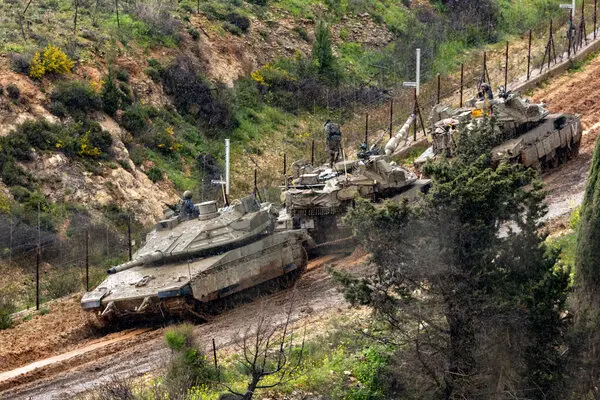
Israel continued its bombing and occupation of Lebanon on Tuesday, with more than 2,089 people reported killed since March 2, according to Lebanon’s Health Ministry. Israeli strikes targeted over 60 locations across Lebanon on April 13, based on field reports compiled by Courtney Bonneau and posted by Drop Site News.
Brent crude fell below $100 on Tuesday as gas prices remained elevated. AAA reported the national average price of gas at $4.12.
Read the full article here