

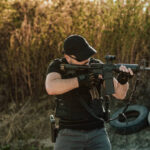
And Other Neck Scarves in Modern Military Service
By Travis Rolph
This short history explores the military uses of the traditional keffiyeh, often called a shemagh, and other common neck scarves. It draws on historical examples and my own field experience, with an emphasis on their practical value. Political symbolism is outside its scope.
British and Commonwealth Military Use
I first encountered the keffiyeh as a teenager while watching Lawrence of Arabia. Later, T. E. Lawrence’s Seven Pillars of Wisdom became a regular traveling companion. I read it several times, then developed the habit of opening it at random and reading whichever page I landed on.
Traditional Arab Keffiyeh worn by T.E. Lawrence.
Lawrence’s adoption of Arab dress during the Arab Revolt of 1916–1918 served practical and social purposes. Local clothing offered comfort and helped him establish rapport with his Arab counterparts. It also helped communicate his standing among them. The meaning of clothing depended on the local setting; a scarf’s quality or pattern was not a universal indication of rank or leadership.
As I learned more about the Second World War, I began noticing the same head covering in photographs of the Special Air Service (SAS) and the Long Range Desert Group (LRDG) in North Africa. Its advantages were straightforward: protection from sun, sand, and wind, along with comfort in the desert environment.
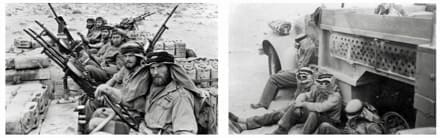
Keffiyeh worn during desert vehicle operations, SAS/LRDG.
British use continued after the war, including during the SAS campaign in Oman. By the 1990–1991 Gulf War, British troops were being issued keffiyehs to protect against windblown sand. Military use continued into the later wars in Afghanistan and Iraq.
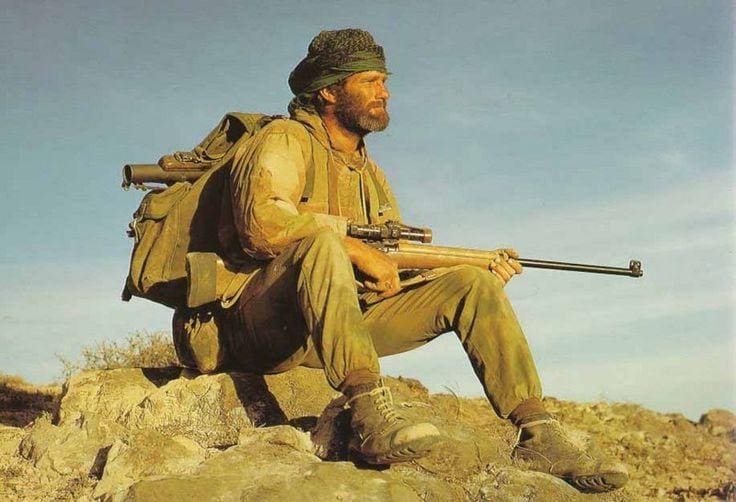
Keffiyeh worn in Oman by an SAS Trooper.
American Service and Field Experience
By the first Gulf War, the keffiyeh was also in use among U.S. personnel. Special Forces teams working with Arab coalition partners adopted clothing that performed well in the heat of the day and the cold of desert nights. Working with our counterparts, we learned that the keffiyeh had uses beyond protection from sun and sand.
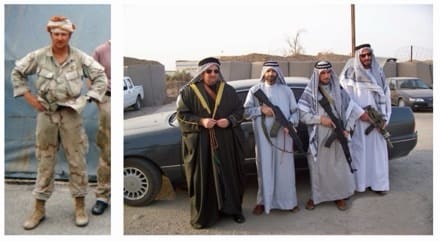
Keffiyeh worn with military uniform and local dress, modern operations.
It could serve as a quick camouflage covering, breaking up the outline of the head and shoulders among rocks and low vegetation. On cold nights during dismounted patrols, it could be draped over the shoulders and adjusted easily as conditions changed. This was particularly useful during extended halts after removing a rucksack.
Specific colors and patterns could help friendly elements recognize one another. During close target reconnaissance, local clothing could also help us blend into the surroundings. At longer ranges, it could create a moment of uncertainty for an observer trying to determine whether he was looking at a friend or an enemy.
At other times, the purpose was simply to build rapport. Wearing the colors or pattern associated with a partner unit or local community could express a shared connection. Keffiyehs were often gifts from our counterparts, giving a practical piece of equipment personal significance.
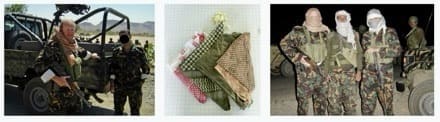
Examples of keffiyeh patterns and their use on operationst.
Other Scarves Used in the Field
Other military neck scarves generally served overlapping purposes: warmth, everyday comfort and utility, and visual recognition. The emphasis here is on utility and recognition.
For U.S. troops, one familiar example was the olive-drab triangular bandage, often folded into a cravat. Worn around the neck or tied over the head as a bandanna or do-rag, it became a recognizable feature of Vietnam War photographs and films. Beyond its medical role, it could absorb sweat, wipe perspiration from the eyes, and provide some coverage against insects around the neck.
British and Commonwealth use of camouflage face veils reaches back to the Second World War. The net scrim scarf became another familiar item of field equipment. I deployed with one for much of my career. It offered some of the same camouflage benefits as a keffiyeh. Its open weave also allowed us to observe through it when it was placed across the opening of a hide site.
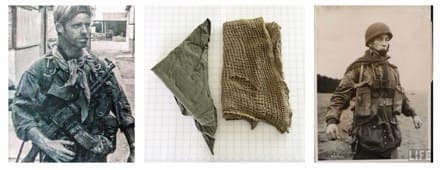
A cravat, a scrim scarf, and examples of their use in Vietnam and WWII.
Vietnam Recognition Scarves
During the Vietnam War, colored scarves and bandannas served as recognition aids among some Special Forces advisers, indigenous troops, and reconnaissance teams of the Military Assistance Command, Vietnam Studies and Observations Group (MACV-SOG).
The reversible version I am describing uses two differently colored triangular pieces sewn together so that either color can be displayed.
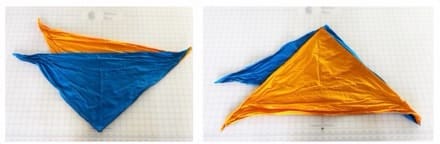
Two views of the reversible blue-and-yellow scarf.
MACV-SOG veterans described teams carrying several separate colored bandannas. Before extraction, the team leader selected a color, informed Covey, the supporting forward air controller, and had the men display it around the head or neck. This helped helicopter crews recognize friendly personnel, especially those wearing North Vietnamese uniforms or carrying weapons also used by the enemy.
They presented the technique as the One-Zero’s (team leader’s) option. It helped reduce mistaken identification and friendly fire during a contested extraction. Their accounts document the recognition method, but do not establish a standard reversible scarf or mandatory procedure.
The version I have came from my father, a forward air controller (Covey) pilot for Command and Control South (CCS). This technique remains a low-tech option for daytime recognition.
This is not an all-inclusive look at nonstandard head and neck scarves, just a snapshot of their use in modern military history.
About the Author
Travis Rolph is a retired Airborne Infantry and Special Forces Soldier and founder of Mayflower Research & Consulting.
Read the full article here
