

For most of my career, carrying marking lights meant accepting an improvised solution.
You taped chemlights to control their output. You tied them together with a cord. You found a way to hang the bundle from your belt or kit. Then you dealt with the weight, the bulk, the snag hazards, and the possibility that one might activate before you needed it.
That was simply how it was done.
I ran that setup through training and operations because everyone else did too. Over time, the inconvenience stopped registering as a problem. It became part of the background, another equipment compromise that professionals learned to work around.
The original MARCO® changed that for me.
Instead of carrying a homemade bundle, I could carry thirty compact marking lights in a protected, magazine-style dispenser. The lights were organized, accessible, and far less likely to activate accidentally. That mattered with visible marking lights, but it mattered even more with infrared. An unintentionally activated IR marker may be invisible to the naked eye, but it is not invisible to someone using the appropriate optics.
That is not just an equipment inconvenience. It is a signature-management problem.
The original MARCO addressed that problem well enough that it earned a permanent place in my equipment. But after years of using, it and training others, I began to recognize another limitation.
The issue was no longer whether I could carry marking lights safely and efficiently. The question was whether I could deploy one without taking attention away from something more important.
Attention Is Part of the Load
When people evaluate tactical equipment, they usually talk about physical characteristics: weight, durability, size, materials, and mounting options.
Those things matter. But they are not the entire load.
Equipment also creates a cognitive load. It may require the user to look down, change grip, confirm an action, perform multiple steps, or pause long enough to make sure that it worked. Individually, those demands can appear insignificant. Under stress, they compete for the same limited attention needed to process the environment, communicate, make decisions, and maintain awareness.
That distinction becomes particularly important in time-compressed situations.
There are circumstances where a team can move deliberately, control its pace, and take the time necessary to solve each problem in sequence. There are also circumstances where delay carries its own consequences. Hostage rescue, active-threat response, and other urgent operations may require people to move and make decisions near the limit of what they can process effectively.
In those environments, even a simple equipment task can become disruptive if it requires the user to shift attention away from the larger problem.
That was the remaining gap I saw with traditional marking methods, and eventually with the original MARCO in specific applications. The original dispenser was safer, lighter, and more organized than a taped bundle, but deploying a light still required a sequence of actions.
Most of the time, that was an acceptable tradeoff. At a higher tempo, it could be enough friction that users chose not to mark at all.
That is an important equipment lesson. If a tool is technically available but its operation competes with the user’s primary responsibility, it may not be available in any meaningful sense.
Marking Is About More Than the First Person Through the Door
Room marking is sometimes treated like a minor administrative action. It is not.
A marking system communicates information to the people who arrive next. It can help indicate which spaces have already been addressed, identify routes or boundaries, support coordination, and reduce unnecessary duplication.
That becomes especially important when multiple elements or agencies are operating within the same structure. Without a clear marking protocol, personnel may spend time reassessing spaces that have already been addressed. They may also encounter people whose movements and positions they do not immediately understand.
Marking does not replace communication, training, or judgment. It supports them by leaving behind a simple, visible piece of information.
But that information only has value if the person placing the marker can do it without giving up attention at the wrong moment.
That is the problem MARCO HR was built to address.
A Different Approach to Deployment
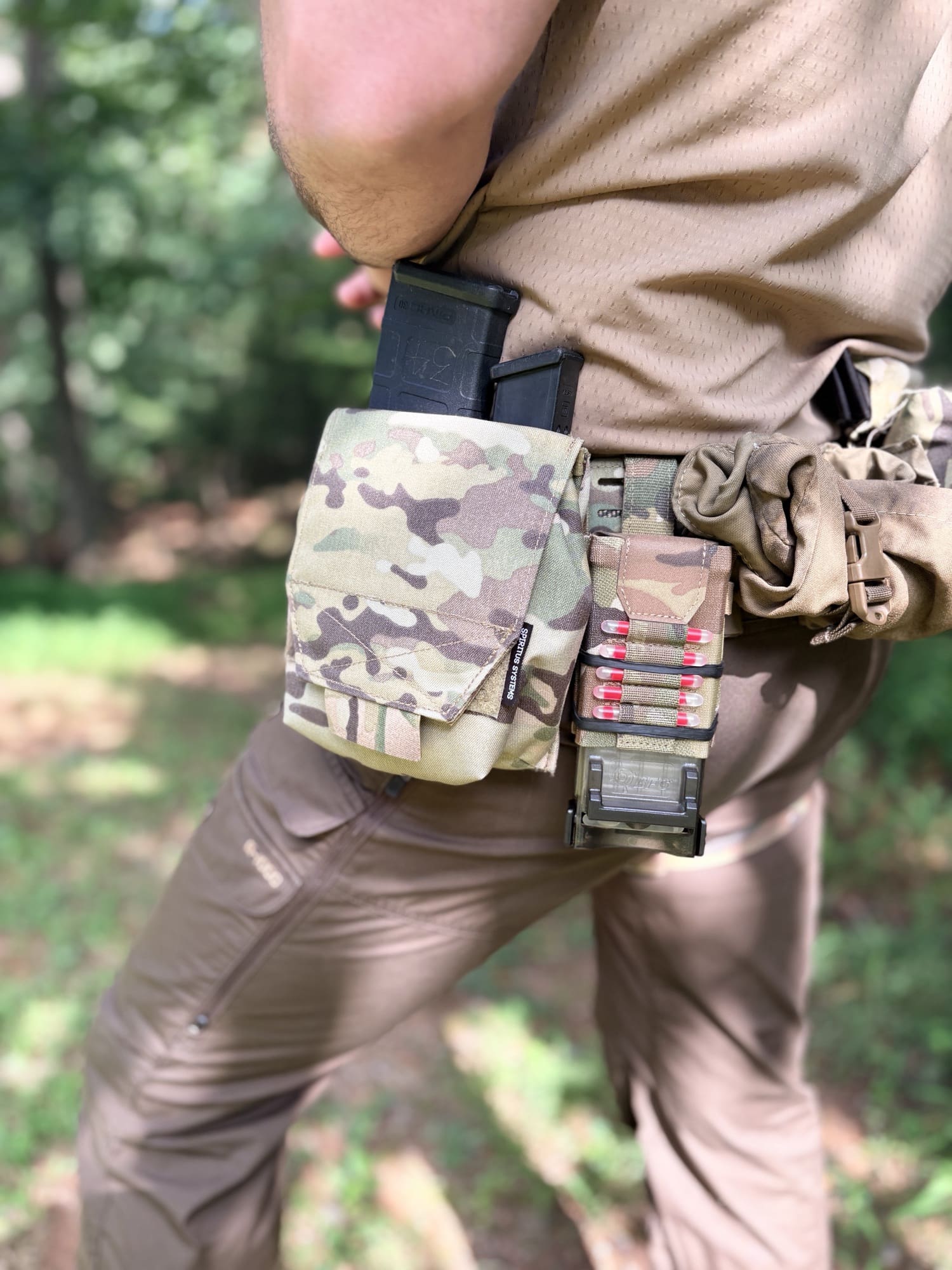
MARCO HR retains the magazine-style concept of the original MARCO, but it changes the deployment action.
The dispenser holds thirty 2-inch marking lights and uses a palm-actuated mechanism that activates and dispenses a light through a single-handed motion. The user does not have to remove a light and then perform a separate activation step. The system is intended to reduce unnecessary handling and minimize the need for visual confirmation.
That is the meaningful difference.
The benefit is not merely that MARCO HR is faster on a stopwatch. The real benefit is that it asks less of the person to operate it. Fewer movements, fewer decisions, and less visual attention are required to produce the same result: an activated marking light placed where it is needed.
MARCO HR can be carried through belt, MOLLE, or drop-hanger configurations and supports multiple marking-light colors for organizations using established visual or infrared marking protocols. The associated Ten-Speed® pouch also provides exterior mounting points for additional marking lights when users need immediate access to a different color or format.
Those options matter, but they are not the real story.
The real story is that marking no longer has to interrupt the work.
Question the Workaround
Professionals are good at adapting to imperfect equipment. That ability is necessary, but it can also hide problems.
If users tape, tie, modify, rehearse around, or simply tolerate the same limitation for long enough, the workaround begins to look like the standard. People stop asking whether the process is still necessary.
The taped chemlight bundle is a good example. It persisted because it worked well enough and because there was no obvious alternative. The original MARCO proved that marking lights could be carried in a more organized and protected system. MARCO HR takes the next step by reducing the attention required to activate and deploy them.
That progression represents more than a product update. It reflects how Blue Force Gear® believes professional equipment should evolve: identify the real problem, remove unnecessary steps, reduce avoidable risk, and make the equipment easier to use under pressure.
Not every mission requires the same speed. Not every team uses the same marking protocol. MARCO HR does not replace sound tactics, communication, or training.
What it does is remove an old equipment compromise.
For professionals working in low-light environments, that is the standard worth pursuing. Equipment should support attention, not compete for it. It should simplify necessary actions without creating another problem somewhere else. Most importantly, it should allow the user to remain focused on the reason the equipment is being carried in the first place.
That is where MARCO HR closes the gap.
Kyle Sproles
Green Beret, Special Forces CQB Instructor, and Founder of Active Shooter Response Solutions
Read the full article here
