
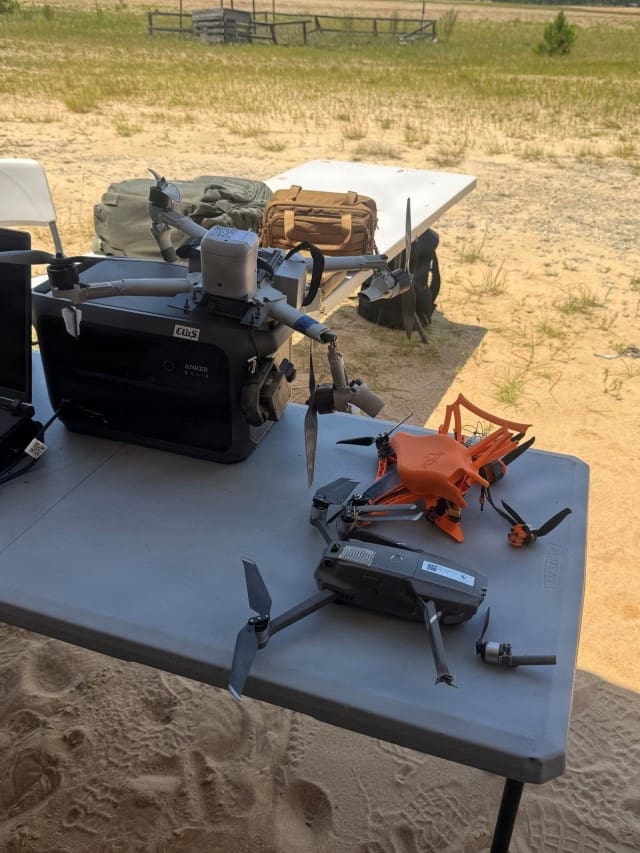
FORT BENNING, Ga. — Joint Interagency Task Force 401 and the 3rd Battalion, 75th Ranger Regiment, completed a comprehensive five-day operational training exercise July 6-10, 2026, at Fort Benning to evaluate and employ the Bumblebee V2 counter-drone system in defense of military installations and domestic critical infrastructure. This training represents the latest tactical integration of low-cost, low-collateral air-to-air interceptors designed to secure domestic airspace and installations from drone threats.
The training at Fort Benning marks a major step forward in transitioning cutting-edge, artificial intelligence-enabled drone technology into the hands of elite rapid-response warfighters. Developed under an initial $5.2 million agreement in early 2026 and scaled under a landmark three-year, $500 million contract awarded in May 2026, the Bumblebee V2 is a next-generation, first-person-view multi-rotor drone designed specifically to hunt and neutralize hostile small unmanned aircraft systems.
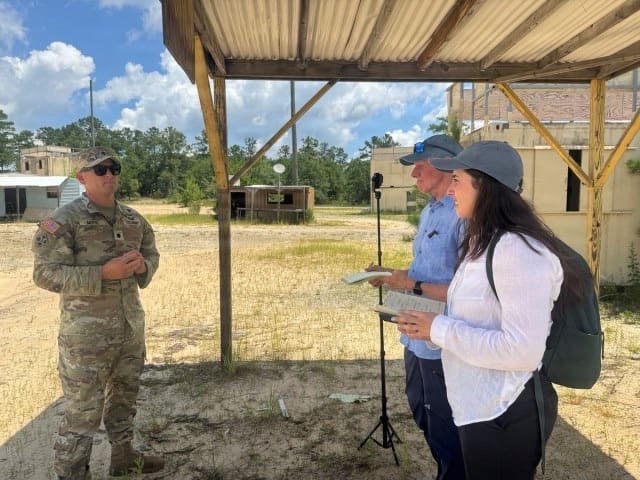
“Our Rangers train to deploy rapidly and operate under the most challenging, high-stakes conditions in the world,” said Lt. Col. Jon Peterson, commander of the 3rd Battalion, 75th Ranger Regiment. “The Ranger Regiment has a long history of pioneering the integration of advanced technologies and operational concepts that can then be rapidly proliferated across the Army and the joint force. Developing top-tier counter-UAS is a priority that requires our immediate action.”
Unlike traditional battlefield kinetic effectors that utilize energetic or explosive payloads, the Bumblebee V2 operates via a pure physical-collision mechanism. The system uses high-speed, direct kinetic energy upon physical contact to render both the interceptor and the threat inoperable, providing a safe, low-collateral solution. This precision-impact capability is optimized for domestic homeland defense under Title 10, Section 130i authorities, allowing commanders to protect critical military installations and national infrastructure without risking lives or property on the ground.
The Bumblebee V2 features an advanced three-camera array with improved gimbal rotation and artificial intelligence-driven automated target recognition. This feature reduces the cognitive load on operators, allowing soldiers to maintain full situational awareness while the drone autonomously tracks and executes hard-kill intercepts in mid-air with operator oversight.
“Securing our domestic airspaces and safeguarding critical infrastructure is both a modern battlefield reality and a vital homeland defense imperative,” said Army Brig. Gen. Matthew Ross, director of JIATF-401. “The Bumblebee V2 gives installation commanders a cost-effective, reliable interceptor that can neutralize threats without endangering our own forces or surrounding infrastructure. As the threat of drones continues to evolve, having a low-collateral kinetic option is essential for homeland defense.”
This training exercise builds directly on earlier operational assessments. These include tests conducted by paratroopers of the 82nd Airborne Division at Fort Bragg in April 2026.
As part of the evaluation event, JIATF-401 assessed a UAS target management capability from DRACOE. Based in North Carolina, DRACOE is a veteran-owned and operated business providing low-cost UAS components paired with a flight software management system that automates representative targets for counter-UAS training. Reducing the training cost and time is a pivotal aspect of JIATF-401’s approach to delivering state-of-the-art counter-UAS capability to warfighters.
By partnering with the 3rd Battalion, 75th Ranger Regiment, JIATF-401 leverages a formation uniquely suited to rapidly evaluate emerging technologies under realistic operational conditions. The Ranger Regiment’s ability to integrate, refine and validate new capabilities helps accelerate the transition of promising technologies into operational use across the Army and the broader joint force. Through this collaboration, JIATF-401 continues to systematically expand the joint force’s capacity to employ layered, non-explosive kinetic defenses against evolving drone threats at home and abroad.
By LTC Adam Scher
Read the full article here