



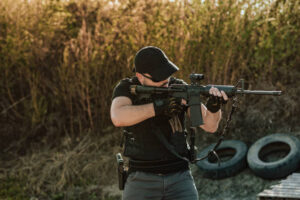
A version of this article first appeared a few weeks ago in Issue 38 of our weekly Soldier Systems Digest newsletter. It was prompted by a vendor demonstrating their candidate carbine leading many to believe the program had already selected a carbine. That is not true. The article has been slightly modified from the original to clarify some points. This is a link to the article we posted after the program was announced in June. It details the requirements. We’ve learned a lot since then.
What HICAR is…
A USSOCOM effort to field a new Stoner-pattern carbine capable of firing the high pressure, 5.56mm cartridge known as M855A1+.
The cartridge has been under development with Federal on behalf of Picatonny Arsenal for several years and referred to as “5.56 Max.”
The cartridge uses Federal’s Peak alloy case technology to deliver chamber pressures in excess of 80,000 psi. This was originally developed for the 7mm Backcountry cartridge.
What HICAR is NOT…
It is not an Army program.
It is not going to replace the 900,000+ M4 carbines currently in Army service.
The Army currently has no plans to adopt M855A1+ ammunition. However, they have paid for its development and are monitoring the program closely.
NGSW remains the Army’s primary small arms modernization effort. In fact, the Army is moving forward with fielding of the XM8 carbine to replace the M7.
The Program as it stands…
There are currently three competitors in down select who will deliver rifles to the command very soon to undergo live fire evaluation. All three companies were directed to NOT publicly acknowledge their participation, so if a company is showing you what they’ve got, they aren’t part of the program.
USSOCOM has POMed (budgeted) for both rifles and ammunition and is dedicated to this program. They currently have courses of action which procure full weapons as well as an Upper Receiver Group-only option. This is why the candidate systems must be M4 compatible.
Numbers are not being publicly disclosed but I would put them as similar to USMC M27 numbers, eventually.
FY27 will see the command down select to one candidate weapon and transition to an OTA for rapid procurement in FY28.
The ammunition…
I have concerns over referring to the ammo as M855A1+. While the HICAR must be capable of shooting standard pressure rounds as well as the new ammo, the inverse isn’t true for legacy M4s. It’s quite possible that high pressure wounds will end up in standard M4s. This is particularly the case for enablers who will likely not be armed with HICAR but embedded within SOF formations operationally. Will this result in catastrophic failures? No, but those high pressure rounds will certainly curtail the life of the M4. However, the danger does exist that an M4 firing M855A1+ may face broken bolt lugs or other failures during a fire fight.
It is my understanding that the ammunition has been safety certified, including passing an obstructed barrel test on an M4A1.
I assert the ammo absolutely needs a new nomenclature and DODIC. I’m also not a fan of the “hyper” velocity moniker. We may one day actually create true hyper velocity ammunition which is in excess of 5,000 fps. This ammunition, while impressive, doesn’t even approach that velocity.
An additional point is that the current developmental ammo (M855A1A+) is tightly controlled and not available outside of this program. I fully expect the ammunition to change over time, as they continue to dial-in its performance. That means, anyone outside of the program is producing their own ammunition. There is currently NO commercially available high pressure ammunition.
While I fully believe that high-pressure ammunition is the future, it faces a serious commercial challenge.
The Sporting Arms Ammunition Manufacturers’ Institute sets industry standards for ammunition. When a new ammunition is proposed, SAAMI certifies both the cartridge and chamber. This is because the camber must be capable of safely firing the ammunition it is associated with.
Most companies in industry will be reticent to offer new ammunition which has not been built to a chamber spec. In this case, .223 for commercial sales. For years we’ve heard about the “dangers” of firing military-grade 5.56mm NATO ammunition in .223 chambers. Consequently, many commercial carbines use barrels chambers for 223 Wylde instead. However, those concerns are laughable compared to the pressures we are seeing with high pressure ammo.
Considering what happens to 300 BLK ammunition fired in .223 carbines, fear mongering will assuredly ensue in firearms social media once commercial high pressure ammunition is introduced.
We are likely stuck in a chicken-or-the-egg cycle, at least in the near-term as ammunition companies weigh whether or not it is worth loading ammunition for firearms that don’t yet exist in great numbers. This is the same thing that happens every time a new caliber is introduced.
The future is high pressure but I believe the military will lead the way in its adoption.
Eric Graves
Founder, SSD
Photo by K. Kassens
United States Army John F. Kennedy Special Warfare Center and School
If you’d like to subscribe:
Read the full article here
