

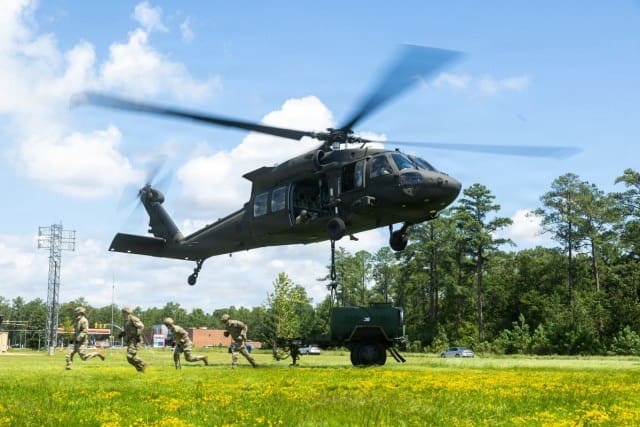
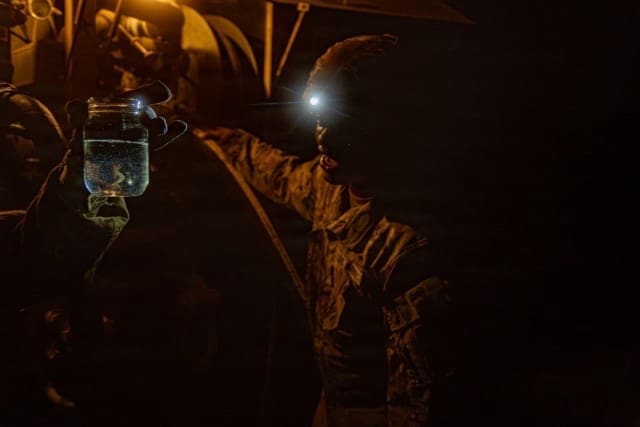
FORT BRAGG, N.C. — Bracing against the crushing downwash of a hovering UH-60 Black Hawk helicopter, a U.S. Soldier grasped a static discharge wand to ensure a safe sling load hookup. Across the training area, another team meticulously tested fuel samples for contaminants and monitored pressure gauges as they prepared to refuel an AH-64 Apache.
These Soldiers were not aviation crew chiefs. Instead, they were 3rd Special Forces Group (Airborne) logisticians; including motor transport operators, fuel specialists and supply clerks. Understanding the complexities of non-standard logistics required to sustain military operations in austere environments, 3rd SFG(A) logisticians are leaning forward to keep pace with evolving security challenges, building an expeditionary refueling point and conducting sling-load resupply operations in a rugged, bare-bones environment.
As the joint force retools for large-scale combat operations, the sprawling forward operating bases and predictable, iron-mountain supply chains of the past two decades are no longer a sustainable logistics model. Contested logistics require decentralized, agile sustainment nodes that can establish, supply and displace before enemy reconnaissance can deem them a viable target.
For Army Special Operations Forces, that reality places unprecedented demands on support elements.
“Operating in a contested environment means our sustainment must adapt,” said U.S. Army Maj. Erica Gaughan, support operations officer for 3rd SFG(A), as she described the importance of fuel access and resupply procedures. “By training these organic FARP and aerial resupply capabilities, we are better prepared to provide rapid, decentralized sustainment to extend our operational reach and maintain high tempo operations. Additionally, cultivating cross-trained logisticians provides the Group with combat multipliers who can handle varied requirements across different specialties.”
Building that organic capability inside 3rd SFG(A) requires overcoming real-world friction. Between force restructuring, targeted resource alignment and competing operational deployments, no single unit possesses all the equipment or manpower sitting idle to support these requirements.
The Group Support Battalion partnered with 1st Battalion’s Forward Support Detachment to pool resources to build and validate the capability themselves. Together, they combined personnel, heavy equipment, grounding rods and sling sets to build the capability themselves.
“What we are doing is showcasing for the force that even post-transformation, this is a capability that 3rd Group maintains,” said Sgt. 1st Class Nicholas Kelly, a senior logistical planner for 3rd Group. “We wanted to show the formation that although this is not something we do on a day-to-day basis, we are multifunctional logisticians who can deliver results. Green Berets require immediate, expeditionary support downrange, and we are here to provide it.”
To transform these multifunctional Soldiers into a disciplined expeditionary package, 3rd SFG(A) is executing a deliberate, three-phased crawl-walk-run progression built on shared standards.
Phase one grounded Soldiers in the classroom, harmonizing standard operating procedures and establishing critical safety baselines for working around spinning rotor blades. Phase two shifted directly to the motor pool, where Soldiers tackled preventative maintenance checks, gathered dispersed components and pressurized complex fuel distribution systems to guarantee every manifold was leak-free and mission-ready.
The third phase served as the crucible, taking the training to the flight line and remote dirt landing zones. Soldiers worked directly under the blinding wind of spinning helicopter blades to practice cold refueling, which involves pumping fuel only after the aircraft is completely shut down. Finally, they stood directly beneath hovering aircraft to perform high-risk static-line sling-load hookups, securing cargo bundles and 400-gallon M107 water trailers to the bottom of the helicopters for transport.
The true measure of the exercise went far beyond the amount of fuel pumped or the cargo nets rigged. It proved that junior enlisted Soldiers and noncommissioned officers can take complete ownership of complex combat tasks and find solutions to unique challenges facing special operations. In ARSOF, where small teams must operate in hostile, denied and politically sensitive environments, this decentralized capability is critical to executing sustained military operations. Survival depends on small-unit logisticians who can independently sustain the fight without relying on massive, vulnerable supply lines.
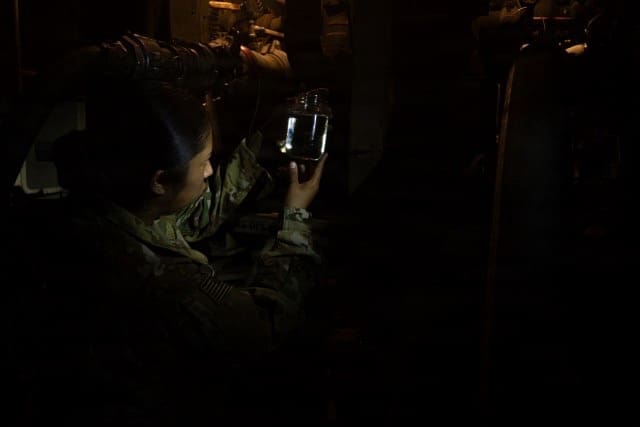
“I’m very impressed by the coordination and initiative shown by our junior leaders and NCOs to resource personnel and equipment across the Group despite competing operational and training requirements,” Gaughan said. “Seeing our NCOs lead from the front, teaching junior soldiers to confidently test fuel and hook up sling loads, is exactly how we build mature, independent, multifunctional logisticians who can serve as trusted subject matter experts when attached to special operations teams.”
When ARSOF deploys to remote environments where threats prevent routine manned flights, they cannot afford a bloated logistical footprint. The organic support personnel assigned to these teams must be versatile problem solvers. They must be capable of troubleshooting fuel pumps, rigging emergency aerial resupply and operating communications systems simultaneously.
By proving that multi-disciplined logistical teams can pool resources and project sustainment organically, 3rd SFG(A) is establishing a repeatable blueprint for the future fight.
“By developing these highly mobile, expeditionary capabilities, we directly enable the lethal, distributed operations required in LSCO,” Gaughan emphasized. “It proves that even during periods of heavy transformation and force restructuring, our sustainers will continue to find creative ways to keep our detachments fueled, supplied, and ready to win in any environment.”
SSG Austin Baker
Read the full article here
